Beyond the Workshop: How Online Custom CNC Manufacturing Prepares ITI Graduates for 80% Faster Career Entry
Introduction
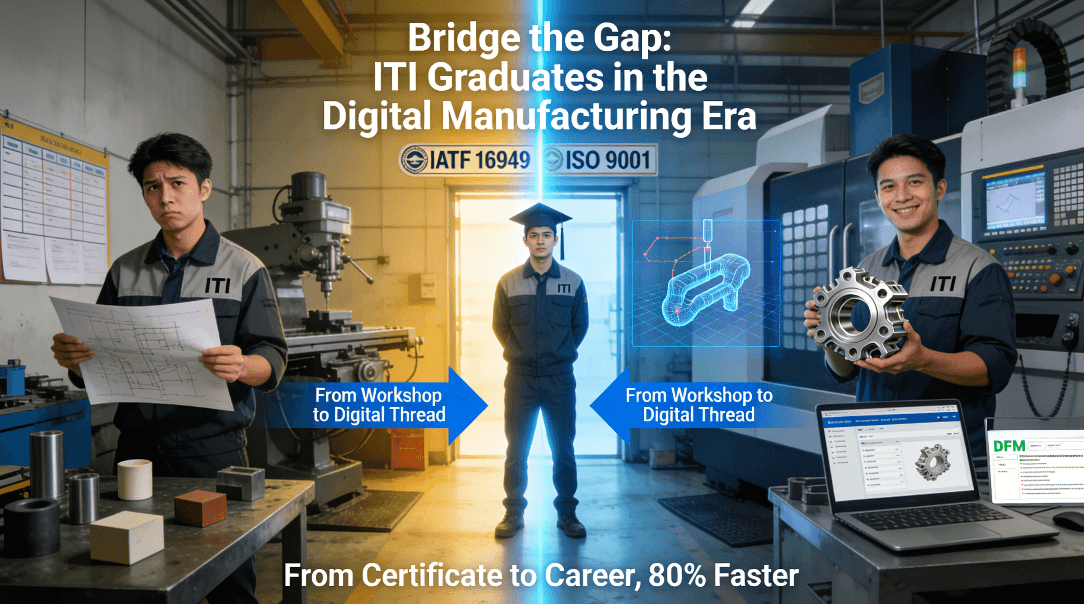
Many Industrial Training Institute graduates leave their well-equipped workshops only to face a stark reality upon entering the workforce: a significant disconnect between their acquired skills and industry demands. Trained on standard machines with simplified parts, they are now expected to interpret complex 3D drawings, work with diverse materials, and collaborate on digital platforms. This “skills gap” often necessitates months of additional on-the-job training, delaying their professional launch and reducing their initial productivity.
The root cause is a traditional vocational education model focused on operating standardized equipment, while modern manufacturing is increasingly defined by digital workflows, customization, and supply chain agility. Graduates lack exposure to real-world, low-volume, high-complexity projects, leaving them unable to translate theory into the open-ended problem-solving abilities employers seek. This article explains how online custom CNC manufacturing platforms serve as a powerful “virtual bridge,” systematically shortening the industry acclimation period for graduates.
From Lathe to Laptop: What Digital Skills Are Factories Really Hiring For?
The manufacturing shop floor of today is as much a digital environment as a physical one. While core competencies in milling, turning, and measurement remain vital, the most sought-after skills are now digital. Hiring managers prioritize a candidate’s ability to interpret a 3D CAD assembly in software like Fusion 360, understand the basics of G-code, and communicate effectively via project management platforms over pure manual machine proficiency. This shift reflects the industry’s move towards integrated digital threads.
1. The New Mandate: Digital Fluency
Authorities like the National Institute of Standards and Technology (NIST) frame digital skills as central to the future manufacturing workforce. The ability to navigate Computer-Aided Design, Manufacturing, and Engineering (CAD/CAM/CAE) software is no longer a specialty; it is foundational. This fluency allows graduates to understand the entire journey from a digital model to a physical part, making them instantly more valuable as collaborative team members who speak the language of modern engineering.
2. Collaboration in a Cloud-Based Ecosystem
Modern production is collaborative and often distributed. Skills in using online portals for file sharing, revision control, and project tracking are critical. An ITI graduate who can seamlessly interact with design engineers and project managers through these digital channels demonstrates an understanding of contemporary workflow, reducing friction and training time from day one. This represents a core component of modern Technical Skills.
3. Bridging the Gap with Practical Platforms
Gaining these skills requires hands-on experience with the tools industry uses. This is where online custom CNC machining services become an invaluable training ground. They provide a real-world interface identical to what graduates will encounter in advanced manufacturing roles. To master how these platforms connect design, engineering, and production, a systematic resource is essential. A detailed guide on custom CNC manufacturing solutions provides a comprehensive breakdown, from introduction to mastery.
Can You “Read” a Part Like an Engineer? DFM Analysis as Your New Superpower
Perhaps the most powerful skill an ITI graduate can possess is the ability to think like a manufacturing engineer during the design phase. This is embodied in design for manufacturability analysis. Using a real part from an online platform as a case study, graduates can learn to identify critical flaws: an internal cavity too deep for standard tools, a wall thickness that invites chatter and deformation, or a tolerance that is unnecessarily tight and expensive.
- The Economics of Prevention: Spotting these issues before manufacturing begins is a high-value skill. It saves companies from costly scrap, rework, and delays. A graduate who can participate in a design review and ask, “Have we considered the tool access for this bore?” or “Can we relax this tolerance without affecting function?” demonstrates proactive engineering thinking that transcends the role of a machine operator. This ability directly contributes to cost optimization and project success.
- Learning the Language of Constraints: DFM is the process of understanding manufacturing constraints. Online platforms often provide automated or expert DFM feedback, which serves as an excellent learning tool. By studying why a certain fillet radius is recommended or why a specific undercut is problematic, graduates build a mental library of design rules. This knowledge is directly applicable to roles in process planning, quality engineering, and Custom Manufacturing Solutions.
- From Feedback to Finished Part: Applying DFM principles is the first step in responsible part creation. The next is understanding how to select the right process and material to bring a robust design to life. This involves evaluating the capabilities of CNC machining for complex components and other processes available through digital manufacturing networks, ensuring the design is not only manufacturable but also optimized for performance and fast delivery CNC machining timelines.
The 90-Second Interview: How to Decode an Instant CNC Quote and Impress Your Boss
In the digital manufacturing economy, cost awareness is a superpower. An instant online CNC quote is not just a price; it’s a detailed data packet that teaches cost engineering. A breakdown typically includes line items for material, machine programming, machining time, setup, and secondary operations. Learning to interpret this quote means understanding the financial drivers behind every design decision.
1. Understanding Cost Drivers
This analytical skill shifts a graduate’s perspective from task executor to business contributor. They learn that choosing 6061 aluminum over 7075 can halve material cost, or that adding a complex 5-axis contour will significantly increase programming and machining time. This awareness allows them to make cost-conscious decisions in their daily work and contribute to value engineering discussions, a key marker of career advancement.
2. The Quote as a Communication Tool
A detailed quote also facilitates clearer communication with clients and managers. Being able to explain why a part costs a certain amount builds credibility and trust. It moves the conversation from “how much” to “how can we optimize,” positioning the graduate as a knowledgeable and strategic partner in the manufacturing process. This skill is integral to roles in Technical Skills like estimation, procurement, and project management.
3. Translating Insight into Action
Therefore, the journey from insightful cost analysis to the delivery of a flawless physical component relies on a capable partner. The knowledge gained from dissecting quotes must be applied through a platform that can reliably execute complex designs. Turning this learned DFM knowledge and cost insight into deliverable, high-quality custom CNC precision parts requires a platform with deep engineering and manufacturing expertise.
Building Your “Digital Portfolio”: Real Projects Before Your First Job
In a competitive job market, a certificate is a prerequisite; a portfolio of real projects is the differentiator. ITI graduates can proactively use online manufacturing platforms to build this crucial asset. They can engage in open-source hardware projects, designing and commissioning a critical component. They can take a personal idea — a custom tool, a robotic part — from concept to finished product using an online service, documenting every step.
- The Story Behind the Part: A powerful portfolio tells a story. It should include the original design intent, the DFM challenges encountered and overcome, the material and process selections made, and photos of the final part. This narrative demonstrates not just the ability to make something, but the ability to engineer a solution — to navigate ambiguity, solve problems, and see a project through to completion. This is compelling evidence of Industry readiness.
- Demonstrating Mastery of the Digital Thread: This process inherently showcases mastery of the digital thread. The graduate proves they can navigate the full cycle: CAD modeling, file preparation, platform interaction, order management, and post-processing. This end-to-end project experience is what employers seek, as it reduces their training burden and proves the candidate can contribute immediately. It is a tangible record of skills in rapid CNC prototyping and project execution.
- Developing a Systemic Quality Mindset: Working with professional manufacturing platforms also instills a systemic view of quality. Understanding how standards like ISO 9001 and IATF 16949 mandate process controls, documentation, and traceability teaches the difference between craft and controlled, repeatable industry-scale production. This systemic thinking is the hallmark of an advanced technician or engineer, setting a graduate apart in the job market.
Case Study: The ITI Grad Who Shortened His Learning Curve by Partnering with a Digital Foundry
Consider the case of an ITI graduate proficient in conventional milling. To bridge the skills gap, he began using an online CNC platform to fulfill small, custom orders in his spare time. Through these projects, he gained hands-on experience with machining parameters for titanium, the strategies behind 5-axis toolpaths, and the nuances of professional client communication regarding specifications and timelines.
1. From Platform Projects to Interview Talking Points
This practical experience provided concrete talking points. When interviewing for a role at an aerospace component supplier, he didn’t just talk about textbook theory. He discussed real challenges he faced machining a thin-walled titanium bracket, how he optimized the toolpath to prevent chatter, and how he validated the final dimensions. His dialogue was that of a practicing manufacturing technologist, not a recent graduate.
2. The Competitive Edge in Hiring
The outcome was a decisive advantage. His demonstrated ability to handle real-world complexity, understand digital workflows, and communicate effectively about manufacturing processes led to a job offer. Notably, his starting salary was approximately 20% higher than peers with similar educational backgrounds but without this practical, platform-based experience. This case underscores the value of proactive skills demonstration.
3. A Repeatable Model for Career Acceleration
This success story is a reproducible model for career acceleration. It aligns with the emphasis placed by organizations like the Society of Manufacturing Engineers (SME) on continuous learning and engagement with real industry challenges. By leveraging online manufacturing platforms, graduates can proactively simulate the early years of a manufacturing career, compressing the experience curve and achieving faster career entry and advancement, solidifying their role as a valuable CNC machining supplier to future employers.
Conclusion
For the modern ITI graduate, the key to career success is no longer found solely in the workshop toolbox, but within the digital networks connecting global manufacturing demand. By actively embracing online custom manufacturing platforms, students can temper their classroom knowledge in the forge of real-world complexity, mastering digital collaboration, cost engineering, and systemic quality thinking long before their first day on the job. This is not merely learning to use a new tool; it is proactively reshaping one’s professional competitiveness to seize the initiative in the wave of manufacturing digitization.
FAQs
Q: As an ITI student with a limited budget, how can I practically use an online CNC service to learn?
A: Start with small, personal projects like a custom tool holder or mechanical puzzle using free CAD software. Upload designs to platforms offering free DFM analysis to learn. For manufacturing, split costs with classmates or use services catering to students with low-cost, rapid CNC prototyping in materials like aluminum.
Q: What specific CAD skills should I focus on learning to be effective with online manufacturing?
A: Prioritize parametric 3D CAD modeling in Fusion 360 or SolidWorks. Focus on creating clean, watertight models and applying basic GD&T. Mastering the export of standard files like STEP or IGES is crucial, as these are essential for professional CNC machining for complex components.
Q: How does understanding the online quoting process help me in a job interview?
A: It demonstrates commercial and operational awareness. You can discuss how design choices impact cost and lead time, showing you think beyond the machine and understand the business of manufacturing, which interviewers highly value for fast delivery CNC machining projects.
Q: Are the skills learned from online CNC platforms relevant for larger, traditional manufacturing companies?
A: Absolutely. Core principles like DFM, reading technical drawings, and understanding process constraints are universal. Experience with digital platforms and online CNC machining quote workflows familiarizes you with the digital thread, central to Industry 4.0 in all major manufacturers.
Q: What is a good first project to design and get quoted to understand the process?
A: An excellent first project is a customized toolmaker’s clamp or small vise jaw. It’s functional, has clear tolerances, and involves basic milling. Getting a quote teaches about material choices, the cost of precision, and the value of design simplicity for custom CNC parts online.
Author Bio
This article is born from ongoing observation of the future talent needs in manufacturing and continuous exploration in partnering with educational institutions to cultivate practice-ready engineers. The insights address the challenge of connecting theoretical knowledge with industrial practice. LS Manufacturing is a certified digital manufacturing partner committed to serving as a bridge for vocational talent, connecting classroom learning with real-world application. Ready to elevate your skills to an industrial grade?