How to Extend the Lifespan of Critical Gears by 300% Avoid Production Line Downtime Caused by Substandard Machining
Introduction
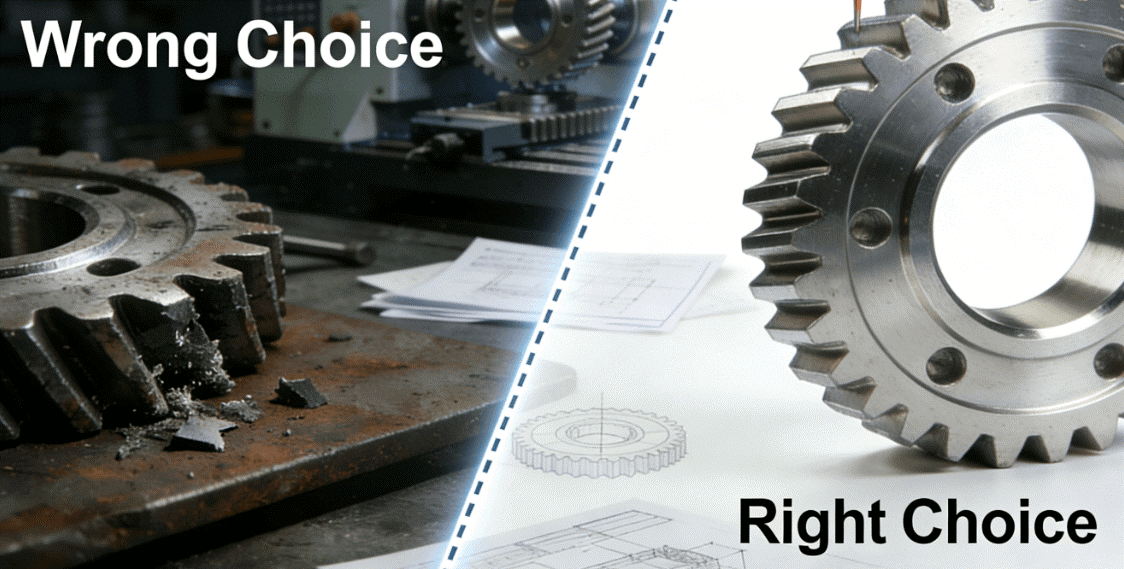
Gears are vital for power transmission, yet manufacturing flaws—poor gear cutting services, imprecise heat treatment, and inadequate precision control—often cause premature failure. This article provides a blueprint for selecting a reliable gear machining service partner by evaluating five critical dimensions: precision mastery, process matching, quality verification, materials expertise, and engineering support.
Is the Ultimate Performance of a Gear Determined Only by the Design Drawing?
A pristine CAD model and theoretical design are merely the starting point for a gear’s life. Between the drawing and the finished component lies a “tolerance gap” dictated by manufacturing capability. The real challenge is how to accurately translate design values into a physical entity through professional gear cutting services, which is the core value of expert gear machining service.
Gear accuracy is not an abstract concept; it is strictly graded by international or industry standards such as those from the American Gear Manufacturers Association (AGMA) or the ISO system. These grades quantify minute deviations in tooth profile, lead, and pitch. According to AGMA, an improvement of one accuracy class (e.g., to Class 12) translates to significantly higher transmission efficiency, effectively lower operational noise, and a multiplied fatigue life. The association emphasizes that the accuracy grade is directly linked to the smoothness, reliability, and durability of power transmission.
Achieving high precision is no simple feat. It depends heavily on advanced CNC machine tools, a stable process system born from years of refinement, and extensive experience in managing material behavior. Merely owning a machine is far from sufficient to consistently produce gears that hit the limits of precision. Therefore, when selecting a partner, one should investigate their proven track record and process depth in stably delivering high-accuracy grade gears, rather than focusing solely on the equipment list.
Hobbing, Shaping, or Grinding? How to Match the Best Process to Your Gear?
Multiple processes exist for gear manufacturing, and there is no “one-size-fits-all” solution. An excellent supplier will recommend the optimal process combination based on the gear’s characteristics, batch size, and performance requirements, striking the best balance between cost and capability.
Gear Hobbing: The Choice for High-Volume Efficiency
Gear hobbing is a continuous generating process known for high production efficiency. It is particularly suitable for the mass production of external cylindrical gears. It can economically achieve good accuracy grades and is a mainstream choice in automotive and general machinery sectors. However, for internal gears or structures with adjacent shoulders and hubs, the hob may not be able to access the tooth space.
Gear Shaping: The Solution for Internal Gears and Special Geometries
Gear shaping is the only efficient process for machining internal gears. The reciprocating motion of its cutter also allows it to machine external gears with features like tight shoulders or flanges where a hob cannot clear. While its production rate is generally lower than hobbing, it is indispensable for specific geometric requirements.
Gear Grinding: The Path to Ultra-Precision and Hardened Surfaces
For finishing gears that demand the highest accuracy, best surface finish, or have been heat-treated to high hardness (e.g., >45 HRC), gear grinding services are an indispensable step.
- Achieving the Highest Quality Grades
Gear grinding corrects distortions induced by heat treatment and can consistently achieve top-tier accuracy levels like AGMA Class 12 or higher, meeting the stringent demands of high-end reducers, aerospace, and precision machine tools.
- Machining Hardened Materials
It is the only effective method for finishing the tooth profile of gears hardened through processes like carburizing or nitriding, ensuring the gear possesses both precise tooth geometry and high surface hardness for wear resistance.
Trend analyses, such as those by the German Engineering Federation (VDMA), note that as demands for transmission efficiency, noise, and longevity increase, finishing processes like grinding are becoming a key trend in high-end gear manufacturing. Partnering with a service provider like CNC Protolabs that offers professional gear grinding services is a reliable way to secure ultra-precise, high-performance gears.
What Risks Are Hidden in “Qualified” Gears Without Data Support?
A gear that is only “qualified” on a few final key dimensions may conceal significant risks of early failure. A comprehensive quality inspection system is not a cost center but a strategic investment to avoid greater losses.
True quality control must go beyond basic dimensional checks and delve into key geometrical tolerances like profile error, lead error, and cumulative pitch error. These micro-deviations directly impact meshing smoothness, load distribution uniformity, and noise/vibration levels. Advanced gear measurement equipment, such as gear measuring centers or CMMs with specialized software, is essential for these precise inspections, providing quantitative data for process control and final verification.
More importantly, a complete quality documentation chain—from raw material certificates and heat treatment reports to full dimensional inspection reports—forms the gear’s “medical record.” This is crucial not only for issue traceability but is also fundamental for compliance with stringent industry standards in automotive (IATF 16949) and aerospace (AS9100D). Choosing a manufacturer certified to international quality management systems like ISO 9001 or IATF 16949 means their quality processes have received third-party endorsement for standardization and reliability.
Beyond “Steel,” What Else Should Be Considered When Selecting Gear Materials?
When discussing the impact of material on gear life, one cannot stop at the alloy grade. The synergy between materials science and heat treatment processes is the “chemical bond” that determines the gear’s final performance.
The same alloy steel, such as 20MnCr5, can yield vastly different properties: deep case carburizing produces a tough core and a hard surface suitable for heavy-load, high-impact conditions, while nitriding offers minimal distortion and extreme surface hardness, ideal for high-speed, precision drives. 42CrMo, after quenching and tempering, offers excellent comprehensive mechanical properties, often used for gear shafts in heavy machinery.
Material selection must be deeply linked to the application. For light-load, corrosion-resistant, or quiet operation needs, engineering plastics (like POM, PA) are excellent choices; for high-temperature or corrosive environments, stainless steel may be required. A proficient gear cutting company should possess metallurgical knowledge to recommend the optimal combination of “base material + heat treatment + surface treatment (e.g., phosphating, plating)” based on the gear’s load spectrum, speed, lubrication, and operating environment, thereby maximizing resistance to pitting, wear, and bending fatigue for extended gear life.
How Does a True Partner Differ from an Ordinary Supplier in the Project’s Early Stages?
A “supplier” manufactures to print and delivers parts. A “partner” co-designs and delivers solutions. The core difference lies in the depth of involvement in the project’s early phases, with its value concentrated in Design for Manufacturability (DFM) analysis.
From Maker to Co-Designer
A true manufacturing partner engages at the design stage, reviewing drawings to propose optimizations. This early collaboration drastically reduces project risk and total cost over the product lifecycle, shifting the relationship from passive order-taking to active co-creation.
The Tangible Value of DFM Analysis
Professional Design for Manufacturability (DFM) analysis is where theoretical designs are refined for real-world production and performance.
- Proactive Problem Prevention
DFM covers suggesting micro-modifications for load distribution, optimizing root fillets to prevent stress fractures, and rationalizing tolerances to avoid unnecessary cost without compromising function.
- A Case in Point
For example, a partner’s DFM review identified a stress concentration risk in a client’s gear due to a small root fillet. Their recommended redesign increased fatigue life by 30% in testing, preventing potential field failures. This upfront engineering is crucial for success.
Conclusion
Selecting a gear machining service is a technical decision that profoundly impacts the long-term reliability and total cost of ownership of equipment. Moving beyond simple price comparisons to systematically evaluate a supplier’s comprehensive capabilities in ultimate accuracy achievement, scientific process matching, closed-loop quality inspection, material and heat treatment expertise, and front-end DFM support is the only way to obtain high-performance, long-life gears. Choosing manufacturers with complete international certification systems (e.g., ISO 9001, IATF 16949, AS9100) provides trustworthy assurance for demanding applications, from quality processes to final performance.
Author Bio
The author is a precision manufacturing solutions expert with over 15 years of experience, specializing in advanced manufacturing technologies for transmission components and complex structural parts. His insights are derived from in-depth involvement in hundreds of successful gear projects, from prototyping to mass production.
FAQs
Q1: How long does it typically take to get a custom, small-batch, non-standard gear?
A1: Lead time depends on gear complexity, material, and processes. Rapid prototypes for simple gears may take 1-2 weeks, while batch production involving complex machining and heat treatment could require 6-8 weeks. A professional service provider will provide a clear timeline in the quotation.
Q2: Can you reproduce a gear based on a damaged old sample?
A2: Yes. Through reverse engineering techniques, the dimensions and parameters of the old gear can be precisely measured and replicated. Performance can even be upgraded using modern materials and processes to create a replacement or improved part.
Q3: For gears in high-load applications, what are the most important performance indicators?
A3: Beyond dimensional accuracy, surface hardness (for wear resistance), core toughness (for shock resistance), and good surface finish (to reduce friction and wear) are critical. This is typically achieved through suitable material selection paired with heat treatments like case carburizing.
Q4: What are the main advantages and limitations of plastic gears compared to metal gears?
A4: Advantages include light weight, self-lubrication, low noise, and corrosion resistance. Limitations are generally lower strength, temperature resistance, and wear resistance compared to metals, making them more suitable for light-load, low-speed, or noise-sensitive applications.
Q5: How can I tell if a gear machining quotation is reasonable and transparent?
A5: A reasonable quote should clearly list material specifications, the proposed machining processes, the target accuracy grade, included heat and surface treatments, and the quality documentation provided. Overly simplistic quotes or those significantly below market average may conceal compromises in process or quality.